
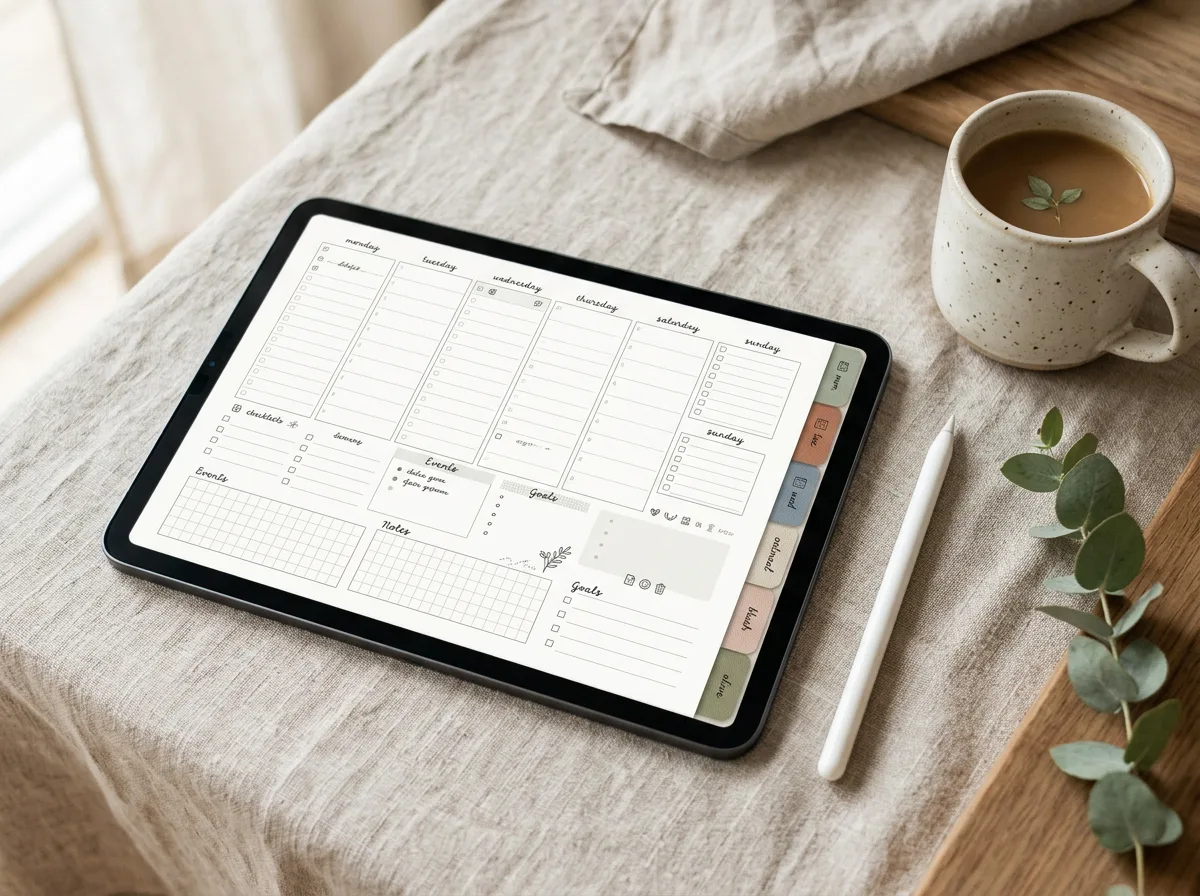



A year is long enough to put things off. A week is too short to make real progress on anything big. A quarter, roughly 12 or 13 weeks, sits in the sweet spot: long enough for meaningful results, short enough that the deadline feels real from the first week.
Short answer: to plan your quarter with 12-week goals, choose one to three goals that matter most, write each as a specific, measurable outcome, break it into weekly actions you control, schedule those actions in your planner, track completion every week, and hold a short review at the end of the quarter before setting the next one. Treat each week as a meaningful chunk of the goal rather than waiting for a year-end push.
Why 12 weeks works
The “12-week year” approach, popularised by Brian Moran and Michael Lennington in their book of the same name, treats each 12-week period as its own year. The appeal is psychological: deadlines that feel close tend to create urgency, while annual goals often get pushed to the second half of the year. You don’t need to follow any one book to use the idea. Even calendar quarters (January to March, April to June, and so on) give you a natural rhythm.
Step 1: Look back before you look forward
Spend 15 minutes on the last quarter, even if you didn’t plan it formally:
- What went well?
- What did you start but not finish?
- What took more time than you expected?
- What do you want more or less of?
This keeps you from repeating the same over-ambitious plan every quarter.
Step 2: Choose one to three goals
Fewer is better. Three goals is a common ceiling; many people do best with one main goal and one smaller one. Spread them across areas of life if that matters to you, such as work, health and finances.
Write each goal as an outcome you can check at the end of week 12:
| Vague goal | 12-week goal |
|---|---|
| Get fit | Run 5 km without stopping by the end of week 12 |
| Save more | Save $1,200 into an emergency fund |
| Grow my shop | Publish 15 new products and write 6 blog posts |
| Learn Spanish | Complete levels 1 and 2 of my course and hold a 10-minute conversation |
| Get organised | Clear and organise every room in the flat, one per week |
Step 3: Turn goals into weekly actions
Outcomes depend partly on luck; actions are fully in your control. For each goal, list the weekly actions that will most likely produce it.
Example: run 5 km by week 12
- Run three times a week following a beginner plan
- Do one strength session a week
- Lay out running clothes the night before each run
Example: save $1,200
- Transfer $100 every payday (twice a month)
- Review spending every Sunday
- Sell one unused item a week
If saving is one of your goals, a zero-based budget spreadsheet makes the weekly check-in much faster.
Step 4: Set it up in your planner
Most digital planners include goal or quarterly pages. Here’s a simple setup that works in any planner, digital or paper:
- Quarter overview page: your goals, why they matter, and the measurable finish line for each.
- Weekly action list: the repeating actions for each goal, written once.
- Weekly pages: schedule each action in a specific time slot. Our guide to time blocking in a digital planner explains how.
- Score tracker: a small table of 12 weeks where you record what percentage of planned actions you completed.
Step 5: Track your weekly score
At the end of each week, count the planned actions you completed and divide by the total. If you planned 10 and did 8, your score is 80%.
The 12 Week Year book suggests that around 85% execution is a strong target; treat that as a guideline rather than a rule. The real value is the trend: if you’re consistently below half, your plan is too big and should be trimmed.
| Week | Planned actions | Completed | Score |
|---|---|---|---|
| 1 | 10 | 9 | 90% |
| 2 | 10 | 6 | 60% |
| 3 | 8 | 7 | 88% |
Your weekly review is the perfect time to record the score and adjust next week’s actions.
Step 6: Plan for the messy middle
Weeks five to eight are where motivation often dips. Plan for it:
- Schedule a mid-quarter check-in at week six.
- Allow one “buffer week” for catch-up, holidays or illness.
- Keep the goal visible on your weekly pages.
- Celebrate small milestones, like your first 3 km run or first $500 saved.
Step 7: Review at the end of the quarter
After week 12, take an hour to review:
- Did you hit each goal? Partly? Not at all?
- Which actions made the biggest difference?
- What got in the way?
- What will you keep, change or drop next quarter?
Some people take a lighter “week 13” for rest, review and planning before starting the next cycle. That’s a useful way to avoid burnout.
Common mistakes
- Too many goals. Five goals in 12 weeks usually means none get proper attention.
- Outcome-only plans. Without weekly actions, goals stay wishes.
- No tracking. If you don’t measure, you won’t notice slipping until week ten.
- Never adjusting. A plan is a draft. Trim it when life changes.
- Skipping the review. Lessons from one quarter make the next one easier.
FAQ
What’s the difference between quarterly planning and the 12-week year?
Quarterly planning simply sets goals for each three-month period. The 12-week year is a specific method that treats each 12-week block as a full “year” with weekly scoring. You can use the scoring idea with ordinary calendar quarters.
How many goals should I set for 12 weeks?
One to three. If you’re new to goal planning, start with one main goal so you can learn what pace is realistic for you.
What if I fall behind in week four or five?
Shrink the plan rather than abandoning it. Cut the weekly actions to the one or two that matter most, and keep going until week 12.
Leave a Reply