


Gaps happen. People take time off to raise children, care for a relative, recover from illness, relocate, study, travel, or simply because a job search took longer than planned. A gap on its own rarely sinks an application. What hurts is leaving the reader to guess.
Short answer: explain an employment gap on your resume with one short, factual line in your work history (for example “Career break: family caregiving, 2023–2024”), mention any skills, courses or projects from that time, and save the fuller explanation for your cover letter or interview. Be honest, keep it brief, and turn the conversation toward what you’re ready to do next.
Do you need to explain the gap at all?
Not every gap needs a label. Use this as a rough guide:
| Gap length | What to do |
|---|---|
| A few months | Usually nothing. Listing years only (2021–2023) is a common, accepted format. |
| Six months to a year | A brief line on the resume or a sentence in your cover letter helps. |
| More than a year | Add a short entry in your work history so the timeline reads clearly. |
One caution about showing only years: it’s a normal convention, but if an application form asks for exact months, give them accurately. Never adjust dates to hide a gap; employment dates are easy to check and a mismatch damages trust far more than the gap ever would.
How to list the gap on your resume
Treat the gap like a short entry in your experience section. Give it a neutral title, the dates, and optionally one or two bullet points.
- Career break: full-time parent (2022–2024)
- Family caregiving (2023)
- Health leave, fully recovered and returning to work (2021–2022)
- Relocation from Canada to Vietnam (2024)
- Travel and independent study (2019–2020)
- Job search and freelance projects (2023–2024)
You don’t need to share medical details or private family matters. “Health leave” or “personal leave” is enough. The phrase “fully recovered” or “ready to return” can be useful because it answers the reader’s unspoken question.
Add what you did, if it’s relevant
If you studied, freelanced, volunteered or built something during the gap, list it. Examples:
- Completed an online certificate in project management
- Managed bookkeeping for a family business
- Built and maintained a small online store
- Volunteered weekly as a tutor at a community centre
These entries show that your skills didn’t stand still. If you’re tracking income and expenses for side projects, a simple bookkeeping spreadsheet is a nice concrete example to mention.
Wording for your cover letter
The cover letter is the right place for one or two sentences of context. Keep the tone matter-of-fact and spend most of the paragraph on the future.
Caregiving: “From 2023 to 2024 I stepped away from work to care for a family member. That chapter is now closed, and I’m keen to bring my experience in client accounts back to a full-time role.”
Layoff and job search: “My previous role was eliminated in a restructuring in early 2024. Since then I’ve completed a data analysis course and taken on two freelance reporting projects.”
Parenting: “After three years at home with my children, I’m returning to marketing. I’ve kept current through a digital marketing course and by running social media for a local parents’ group.”
How to answer in an interview
Interviewers usually ask about gaps out of curiosity, not suspicion. A simple three-step answer works well:
- State the reason in one sentence. “I took a year off to care for my father.”
- Mention anything you did to stay sharp. “During that time I completed an Excel certification and kept in touch with former colleagues.”
- Pivot to now. “I’m ready to commit to a full-time role, and this position fits what I want to do next.”
Practise it out loud until it takes about 30 seconds. Over-explaining makes a gap sound bigger than it is.
Resume formats that help
If your gap is long or you’ve had several, a hybrid resume can help. It opens with a summary and a skills section, then lists work history in reverse chronological order. The reader sees your strengths first, and the timeline is still complete and honest. A purely “functional” resume with no dates can make recruiters suspicious, so most career advisers recommend keeping a dated work history.
Your summary also matters. Write it about what you offer today rather than about the break. If you’re starting from scratch, our guide to writing a resume summary with little experience has a formula that adapts well for returners.
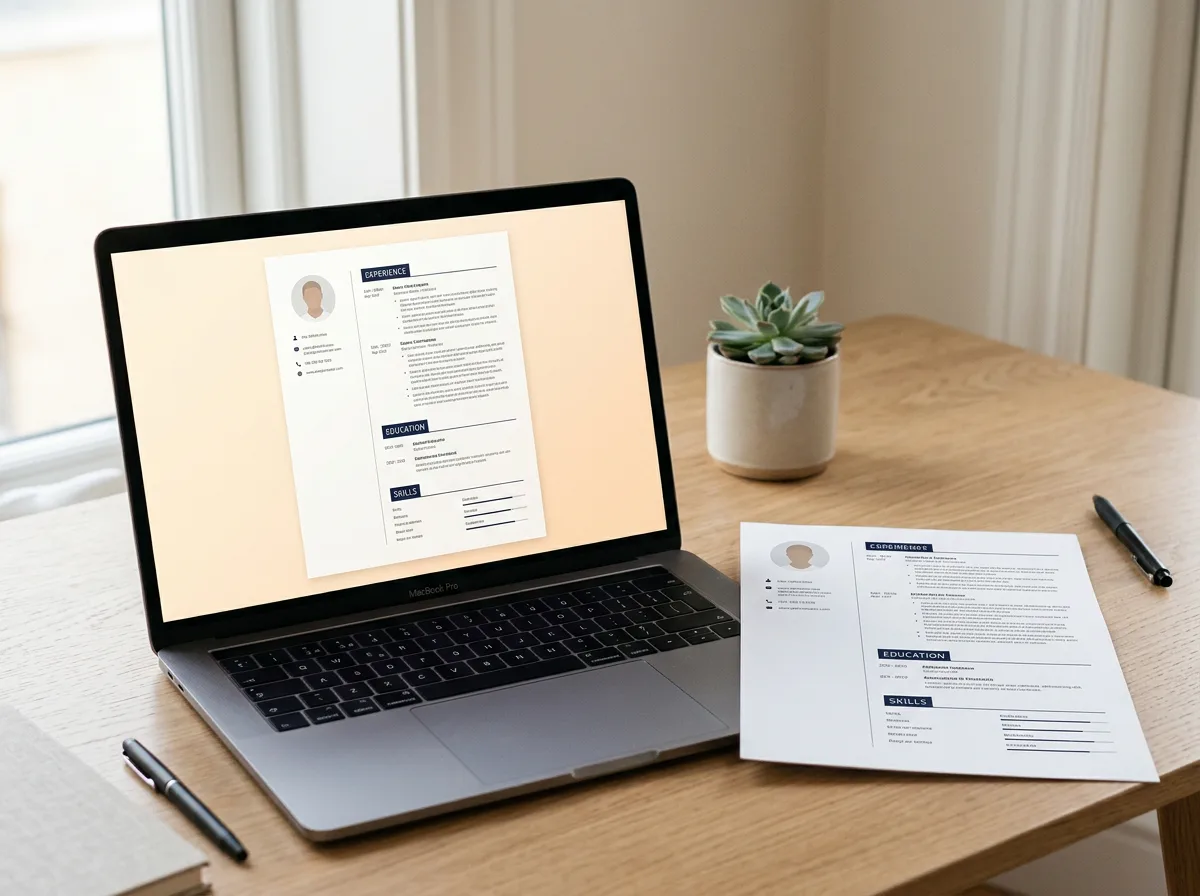
A tidy template removes one more source of stress. Browse our resume templates for layouts with a clear experience section where a career-break entry sits naturally.
Common mistakes
- Hiding it with creative dates. Easy to discover, hard to recover from.
- Over-sharing. You don’t owe anyone medical or family details.
- Sounding apologetic. “Unfortunately I wasn’t working” frames the gap as a failure. State it neutrally.
- Inventing a job or a company. Background checks and reference calls exist. Use freelance or volunteer work only if it’s real.
- Ignoring the gap on LinkedIn. Make sure your online profile tells the same story as your resume. LinkedIn also lets you add a career break entry to your experience section.
FAQ
Is a one-year employment gap bad?
Not necessarily. A one-year gap is common and is usually fine when you explain it briefly and show you’re ready to work. What matters most is how well your skills match the job.
Should I mention a gap if the recruiter doesn’t ask?
On the resume, a short labelled entry is enough. In the interview, you don’t need to raise it unless it’s relevant, but have a calm 30-second answer ready in case it comes up.
Can I leave months off my resume dates?
Showing years only is a widely used format. If an application form asks for months, give them accurately, and never change dates to disguise a gap.
Leave a Reply